
A lesson in intercultural communication
Later that day, my dad called me again and said:
Anna, you’ve spent a lot of time living abroad, so you’re more used to direct communication. This might be one of those cultural differences you’re always talking about. If you can, your sister would really appreciate it if you could babysit your niece. She probably assumed that if you were able to help, you would have offered.
Really?! I replied. She hasn’t asked me, but I’d be happy to do it. Let me check with her. And also, go, Dad, for thinking in terms of cultural differences!
I did check with my sister. And, exactly as my dad predicted, that’s how she saw it. I ended up spending a few hours taking care of my niece, and everyone was happy.
“Why hasn’t she offered?” meets “Why hasn’t she asked?”
What happened there? No one was being inconsiderate. But different communication assumptions were at play. The difference my dad was pointing to is known as high-context vs. low-context communication, a concept first described by Edward T. Hall.
My sister was communicating in a high-context way. In high-context communication:
- Messages are often indirect and nuanced – they are not only spoken but also “read between the lines.”
- Meaning is carried not only by words, but by context, relationships, and shared understanding
- You assume that there is a shared understanding, so there is no need to state the obvious.
In her mind, the situation might have spoken for itself: If Anna can help, she will offer. There was a lot of information in that context that I missed!
I, on the other hand, was communicating in a low-context way. In low-context communication:
- Clarity and precision are valued
- If I need something, I ask for it
- If someone can’t help, they will simply say so
- The responsibility lies with the speaker to make the message clear
I relied almost entirely on what was said, and nothing had been said until my dad called me.
Why this matters in global teams
Even within the same culture, there is often a gap between what we say and what we mean. But when we start working across cultures, that gap becomes wider.
In global teams, these differences can lead to missed expectations, frustration, and misinterpretations of your colleagues’ behaviour: “they’re not helpful”, “they’re not proactive”, “they’re inconsiderate.” When in reality, people often use different communication styles.
See where different countries fall on the Communicating scale in Erin Meyer’s brilliant book “The Culture Map”.
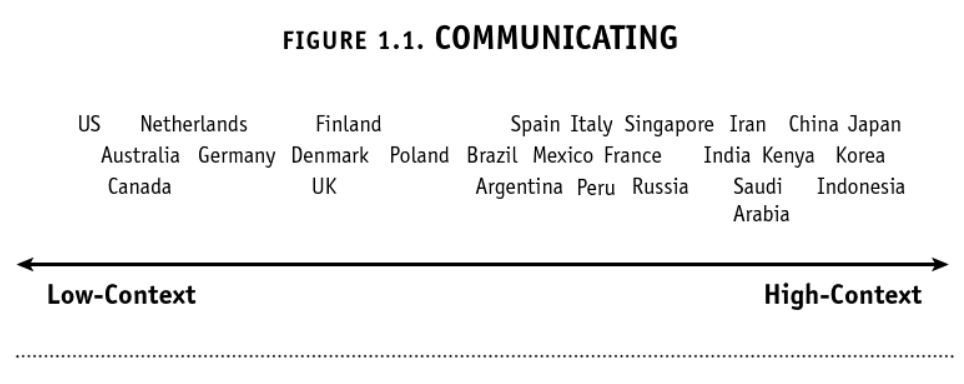
Communication across cultures: a U.S. perspective
In Episode 2 of my podcast What Works Across Cultures, I explore these dynamics with Karen Cvitkovich, an experienced U.S.-based consultant and facilitator.
When I asked her what global team members often get wrong when working with colleagues from the United States, she said:
“One of the things global team members may struggle with when working with U.S. Americans is communicating in a way that is explicit enough.”
This isn’t surprising. The United States is one of the most low-context cultures in the world, where clarity, precision, and simple communication are highly valued.
So what does good communication across cultures actually look like?
- What are the most important cultural differences related to communication?
- How do high-context and low-context communication styles show up in the workplace?
- What is the difference between “being clear” and “being direct”?
- How do you give effective feedback across cultures?
- What are some practical tips to help you communicate more effectively when working globally, especially when collaborating with U.S. team members?
These are the questions we explore in the episode.
🎧 Episode 2: Communication – A Perspective from the U.S. | Karen Cvitkovich. Available on:
- ➡️ Spotify
- ➡️ Apple Podcasts
- ➡️ YouTube
If you enjoy the show, subscribe, share it with your network, or leave a review.
And if this topic resonates with you, this is exactly the kind of work I do with leaders and their teams: helping avoid misunderstandings and communicate more effectively across cultures.
Listen to What Works Across Cultures on: